Fortune favours... well almost everyone

fortune 1.jpg

 In my not particularly extensive experience, horoscopes are a bit hit and miss. My positive love or work experience today might vanish with a new day or a new magazine. To counter this random effect, the Japanese have developed a seemingly fail-safe system to guarantee each punter gets good luck. 

I came across lots of fortune telling in Japan, normally in temples. There were several different sorts of fortune telling machines, which gave you a piece of paper (English available), and there were sticks which you bought from a vendor and had a number on, which related to a fortune.
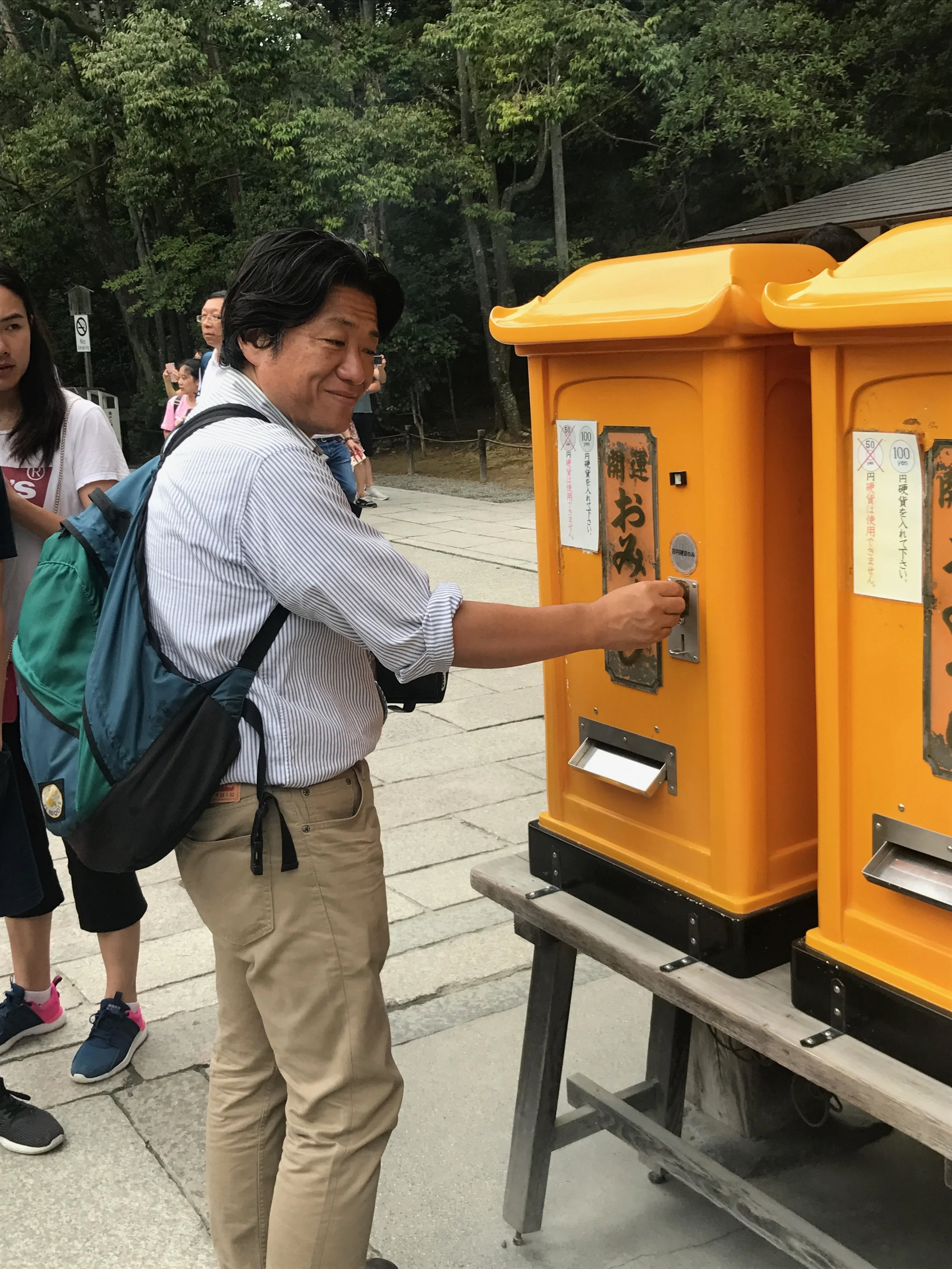
Shiga-san trying his luck with a yellow fortune-telling machine

Shiga-san trying his luck with a yellow fortune-telling machine

But the great thing about the system is that if you don't like your fortune, you get rid of it, and take another one. One temple had this useful box for "unnecessary" fortunes; in another place you tied your unlucky fortune to a sort of washing line outside the temple; only taking home the good ones.

fortune unnec.jpg

Sounds very sensible as a money-making venture for the monks too. Just keep picking (and paying) until you get the fortune you want.

Having a grand day out in Kyoto

Such good tourists

Such good tourists

During our final week in Japan, Shiga-san, Ben's Japanese exchange host father, generously came down from Tokyo to see Zen, and then take Ben and I on a trip to the former Japanese capital of Kyoto, about half an hour from Osaka by express train.

Kyoto is by and large another modern Japanese city - ugly and sprawling. But tucked in among the concrete are some fabulous temples, gardens, houses, and even a traditional area with narrow streets, wooden houses, small shops and restaurants.

Our first stop however was for a more recent cultural invention: fire ramen noodles. In fact, according to the restaurant's website, fire ramen is "the one and only experience in the whole world". Lucky we didn't miss it.

fire ramen 2.jpg

As much a performance as a meal, the charismatic owner ushers around a dozen diners in at a time, yelling at anyone else who dares put their head round the door. Once inside, you put on protective aprons and watch the preparation of the ramen noodles, presumably in much the same way as ordinary noodles in soup, but with the addition of a thick layer of spring onions. Then the chef goes down the row of diners pouring flaming oil on top of the spring onions, which flare up, sending flames to the ceiling. It's nothing like the pretty blue glow when you set your Christmas pudding alight - although a sign assures patrons that the shop has been serving fire ramen for 30 years and "nobody has been dead for now". So that's OK.

It's pretty delicious too, if you like a hint of singed-ness.

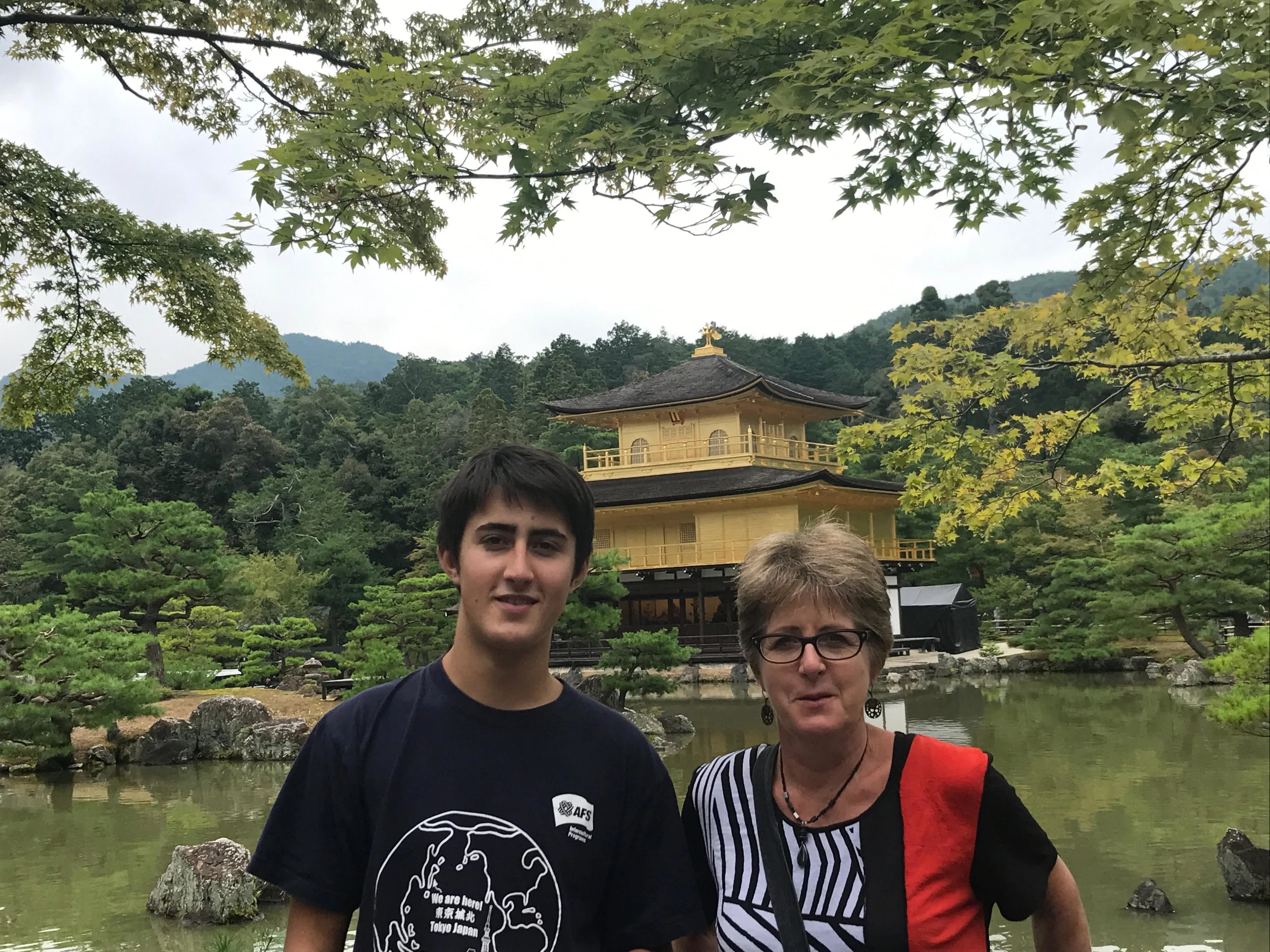
Next we went to the Kinkaku Ji Temple, or Temple of the Golden Pavillion. Fire plays a part in this site too, as the temple was burned down by a novice monk in 1950, so the present, reconstructed, structure dates from 1955. It's fabulous. 

temple 2.jpg
At Kiyomizu-dera. Matching kimonos, matching trousers...

At Kiyomizu-dera. Matching kimonos, matching trousers...

Even more fabulous is the Kiyomizu-dera Temple, which sits in a stunning position on a hillside on the other side of town. When we were there, the trees were just starting to show their autumn colours, the grounds were full of tourists dressed up in kimono, we had green tea (matcha) in a traditional tea house, and bought fortune-telling strips (o-mikuji) from a machine. It was very fine.  I even got my photo taken lifting up a very heavy metal pole with some random rings on the top. I have no idea what it was, or why I was lifting it. But everyone else was doing it...

OK, so Ben could do it with one hand...

OK, so Ben could do it with one hand...

Outside the temple grounds are a cluster of streets with traditional shops and houses; very touristy, but very pretty. Green tea was much in evidence here too, with products - from soap to biscuits - available.  Green tea is obviously the pumpkin of Japan. Is there anything you can't use it for?

katsu 1.jpg

Our last treat was a kushi-katsu dinner in a mall below Osaka central station. A low ceilinged dive sort of a place, the waiting staff wore overalls and white gumboots; the patrons were almost exclusively men in work clothes drinking beer and sake, and eating deep fried stuff on skewers. It would have been churlish not to do the same.

A good day...

Never work with children and selfie sticks

Never work with children and selfie sticks

temple kimono.jpg

Excessive newness - and a few other gripes about Japan

Of course, not everything that's new in Japan is ugly...

Of course, not everything that's new in Japan is ugly...

Having been in Osaka for two weeks now, I'm starting to miss oldness. In particular, old buildings. Beautiful old buildings. Osaka is ostensibly an old city - it was founded in the fifth century and was the capital for a while from 645AD. It has a fine castle and some lovely temples. But other than that, you get the impression the whole place was built in the last 80 years. As I've wandered around the suburb where Saho lives, for example, there are lovely temples, plus the odd traditional wooden house - with its characteristic storm shutters (amado), sliding translucent paper panelled walls (shoji), and shut in outer corridor wrapping around the house.

Spot the old house in Osaka. I didn't photograph one, so this is from the internet

Spot the old house in Osaka. I didn't photograph one, so this is from the internet

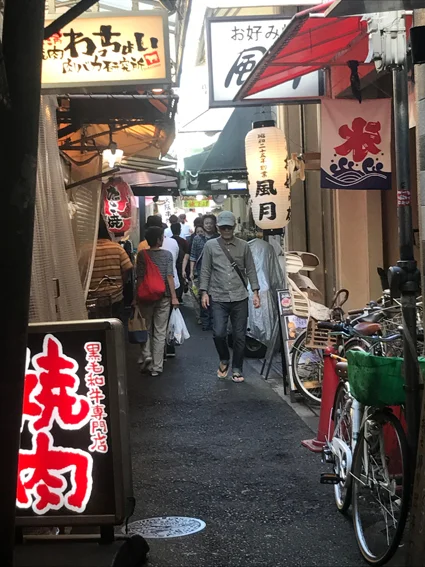
And in the city centre there are areas where the little alleyways remain, with small restaurants and shops, some in old-style buildings, squeezed alongside newer structures. 

osaka alley.jpg

But mostly it's just modern. Ugly modern. 

One problem is that traditional Japanese construction materials - wood, paper, rice, straw and clay - work against longevity. Family homes were historically viewed as temporary and were rebuilt every 20 years or so. In addition, fire destroyed whole neighbourhoods on a regular basis. And WWII American firebombs wiped out a third of Osaka. 

But surely there must have been one old residential area that was saved, or could have been reconstructed using traditional Japanese building styles (with maybe a few non-obtrusive fire retardant features)? A place where locals and tourists could wander around and see what the city used to be like.

As a spoilt tourist, I want Ponsonby or Hampstead, Paris's Quartier Latin, or central Hanoi.

Kyoto's old district

Kyoto's old district

Kyoto, a long-time capital of Japan, has one such area up by the Kiyomizu-dera temple, and it's insanely popular as a tourist attraction. People dress up in kimonos and yukata and clomp around the paved streets in those uncomfortable-looking wooden-soled sandals the Japanese used to wear. 

kyoto old 3.jpg

But even Kyoto, which was spared the American bombs, is mostly another ugly city, a hotchpotch of high- and low-rise blocks and mostly European-style houses. 

A model of what no longer exists - an old Osaka district

A model of what no longer exists - an old Osaka district

If you want to look at old Osaka, you basically need to look at models and reconstructions in the (excellent) Museum of Housing and Living, and the Museum of History, both of which (somewhat ironically) are found high up in central city skyscrapers. Albeit, in the case of the history museum at least, a beautiful skyscraper. 

Osaka museum.jpg

Am I done whinging? Not at all. Why quit when you are on a roll? Here are some other things I find less than perfect - excessive or unnecessary - in this otherwise pretty great country. (See previous blog about the things I like - there are more of them - honest!)

9372D40E-F445-4C62-A993-806FC3B51984.PNG

- Having three different ways of writing. As a way of making it virtually impossible for foreigners to get good at Japanese, it's a master stroke. For anything else it's just bloody-mindedness. Why on earth do you need to use a separate set of characters (katakana) for foreign words? It's like us suddenly choosing the Cyrillic alphabet to write "croissant" (круассан) because it's not originally an English word. Meanwhile, why doesn't the Japanese government just make up its mind whether to use the Japanese alphabet (hiragana) or Chinese characters (kanji)? Look at the back of your bog-standard cereal box and you'll see a crazy mix of all three writing styles in the same paragraph. It must be very hard for Japanese kids learning to read and write. Japan, make a choice.      

dogs.jpg

- Dogs in backpacks. Surely not necessary. Though I would love to know if there's anything inside that little pooch pouch.

Excessive packaging. SIngle-serve peaches with stretchy padding, cellophane and labels; individually-wrapped limes, each with a sticker on the fruit itself, then the cellophane wrapper, labels front and back and a flexi tie. It's a piece of fruit, not a 21st birthday gift...

platform.jpg

- Telling you where to stand on a station platform, and which direction to walk up the stairs from the platform. Chaos is liberating.

stairs.jpg

- School children in uniforms that are identical, including their shoes, socks and satchels. Kids in school uniforms on Sunday. Bowler hats and sailor suits as part of the uniform. Over the top on a five-year-old. 

  • Excessive bowing and thanking. At the Museum of History you are bowed into the building, thanked for your visit and shown to the end of the queue for tickets. As you leave, the security guard bows low and again thanks you. In the local convenience store the cashiers - yes all of them - bow and thank you for frequenting their establishment. It's kind of respectful, but kind of "too much already." I only bought a pint of milk.
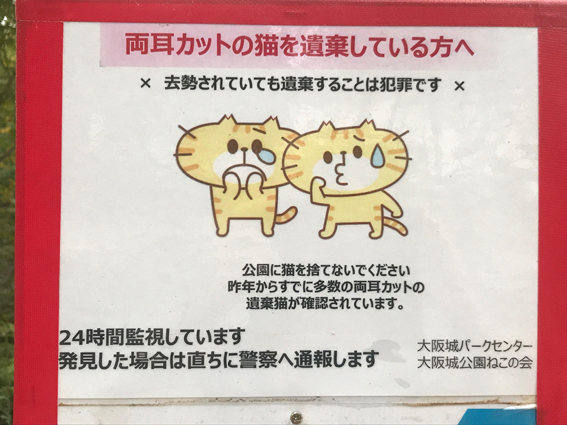
  • People that dump their cats in the Osaka Castle park. As this sign so succinctly puts it, don't do it guys!
cat.jpg